Layer Normalization
- Paper: https://arxiv.org/abs/1607.06450
- Github: https://github.com/sehyunlee217/paper_implementations/tree/main/layer_norm
Issues with BatchNorm that LayerNorm Addresses
LayerNorm addresses a few shortcomings of BatchNorm:
- RNNs or any language-based tasks might have different sequences/lengths of data We can’t simply calculate the statistics across our batches, we also need to consider the time steps.
- As BatchNorm calculates statistics across the batch for each feature, the batch sizes need to be relatively large.
- BatchNorm relies on batch statistics during training and stored running statistics at inference. LayerNorm works independently for each sample, which is useful for online learning and small batches.
Layer Normalization
- LayerNorm computes statistics across the features of each sample, rather than across the batch for each feature.
- Formally, they define the statistics as and , where stands for the th layer, as the inputs to the hidden layer, and as the number of hidden units in the layer.
- So we normalize across the hidden units within a layer, giving each sample its own mean and variance.
- I know the wording can be confusing, so here is a quick example. Say the input is : a batch of 32 images, each with 3 channels and a size of 64 × 64.
- If we perform BatchNorm for this input, we are calculating the statistics for each feature across the batch, so we will calculate statistics as the feature size are the channels for our input and the dimension of the statistics will be , assuming we flatten the 64 x 64 image to one vector.
- If we perform LayerNorm for this input, we are calculating the statistics for each sample in the batch across all features, so we will instead calculate statistics for our input, and the dimension being , again assuming we flatten the image.
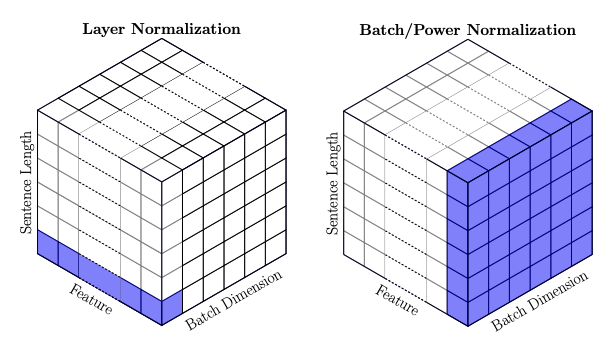
- This image may give a better visualization of how Batch/LayerNorms differ and also an intuitive understanding of why using LayerNorm is the obvious choice for Language modeling.
-
First of all, assume that we are conducting BatchNorm across some input of the language. Then, we are essentially normalizing across the batch for a specific feature vector, which is problematic. For example, assume these two sentences are in a batch: 1. The cat meows. 2. The barking dog looks at the cat.
-
If we normalize each position across the batch, the representation of “cat” depends on “barking” because they occupy the same position. We would prefer to normalize each token independently.
-
The sentences also have different lengths, so padding can affect batch statistics unless it is handled carefully. In our example, the shorter sentence has no tokens corresponding to “looks at the cat”.
-
Therefore, it makes sense to use LayerNorm, where we calculate the statistics across the feature instead of the batches. For our first sentence, “cat” will have its own representation and be normalized within its feature space. So assuming that the features space is of size , we will calculate some and for the word “cat” and normalize that feature vector instead.
-
This way, each token is normalized independently across its features. Attention handles the context between tokens, while positional encoding provides order.
-
I won’t mention too much about the internal covariate shifts as it is covered in detail in my BatchNorm post.
Implementation Details
- The implementation will be pretty straightforward, as it is similar to BatchNorm.
class LayerNorm(nn.Module):
    def __init__(self, eps=1e-5):
        super().__init__()
        self.eps = eps

    def forward(self, x):
        batch_size, length, feature_dim = x.shape
        output = torch.zeros_like(x)

        for i in range(batch_size):
            for t in range(length):
                word_vector = x[i, t, :]

                mu = word_vector.sum() / feature_dim

                var = ((word_vector - mu) ** 2).sum() / feature_dim

                output[i, t, :] = (word_vector - mu) / torch.sqrt(var + self.eps)

        return output
- Here we can try testing out if the layernorm is actually working properly.
# Assume feature vecs from a batch 32, sentence of length 64, and feature dim. of 512.
# We want to normalize across each word in a batch.
# randn() -> mean 0, variance 1; scaled input has mean 10, variance 25
sample_batch = torch.randn(32, 64, 512) * 5 + 10

print(sample_batch[0, 0, :])

ln_layer = LayerNorm()
out = ln_layer.forward(sample_batch)

print(f"dim(out): {out.shape}") # >>> (32, 64, 512)
print(out[0, 0, :])
- Compare
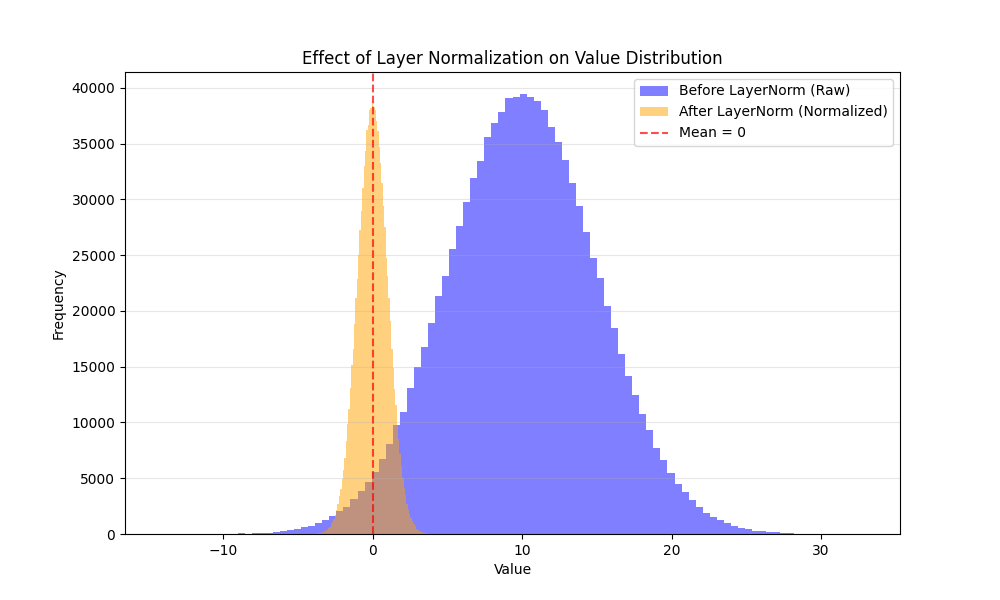
sample_batch[0, 0, :]before and after normalization.torch.randnsamples a standard normal distribution; multiplying by 5 and adding 10 gives a mean of 10 and a standard deviation of 5. - Here we can visually see the effect of LayerNorm on the feature vector for the inputs. Following the example from before, we transformed the feature vector of “cat” to a normalized feature vector.
- We can clean this up with the same PyTorch operations we used for BatchNorm.
keepdim=Truekeeps the reduced dimension so the statistics broadcast back over the input. Here is the vectorized version:
class LayerNorm2(nn.Module):
    def __init__(self, eps=1e-5):
        super().__init__()
        self.eps = eps

    def forward(self, x):
        batch_size, length, feature_dim = x.shape
        output = torch.zeros_like(x)

        # dim=-1 so we squish along last idx(feature_dim)
        # keepdim=True so we get (batch_size, length, 1)
        mu = x.mean(dim=-1, keepdim=True)
        var = x.var(dim=-1, keepdim=True, unbiased=False)

        output = (x - mu) / torch.sqrt(var + self.eps)

        return output